

The Squeaky Care Info
Let's start with the basics
Plasticizers;
What is Plasticizer; Plasticizers are compounds that increase the plasticity or decrease the viscosity of a material. The most common plasticizer used in PVC is phthalates. When added to PVC, they space out the polymer chains, making the material more flexible.
Non Phthalate Plasticizers; Non-phthalate soft flexible PVC plasticizers are additives that increase flexibility and workability in polyvinyl chloride (PVC) without using ortho-phthalates
Application of Plasticizers; The production of soft PVC compounds involves mixing PVC resin with the desired amount of plasticizer and other additives like stabilizers and fillers. This mixture is then heated and rolled into a vinyl cloth.
PVC plasticizers are heat-activated in that heat is required for them to penetrate and soften the polymer during manufacturing (gelation at 184°C / 363°F).
When plasticizers (such as phthalates or citrates) are applied to the surface, they can be absorbed into the PVC matrix, reducing intermolecular forces and increasing flexibility.
But this comes with certain risks and downfalls
The plasticizer being added must match the exact plasticizer and additive compound precisely.
Because the plasticizer is not chemically bonded to the polymer chain, it will eventually migrate out again, causing the PVC to become brittle once more and each time it is applied the duration will shorten, also causing more permeant damage to the base material.
If the wrong plasticizer is used, it may not work, or in some cases, it may cause the surface of the PVC to become sticky or degrade..You must use the exact same plasticizer each time as changes also alter the stabilizer compounds.
Applying random plasticizers to aged flexible PVC presents significant health and safety hazards and can cause severe material degradation. Incompatible plasticizers are not chemically bound to the polymer matrix, meaning they can easily leach out, contaminate the environment, and compromise the physical integrity of the material.
Many plasticizers, particularly certain phthalates like DEHP and DiNP which are common in older PVC products, are known to be toxic. Applying random plasticizers increases the risk of exposure to potentially harmful chemicals with unknown health effects.
Aged PVC is already susceptible to degradation from environmental factors like UV radiation and heat, which cause existing plasticizers to leach out and the material to become brittle. Applying an incompatible plasticizer exacerbates these issues.
What causes Plasticizer Damage & leaching;
Applying the wrong or incompatible plasticizer to aged, flexible PVC (polyvinyl chloride) typically accelerates its degradation, resulting in increased brittleness, surface stickiness (blooming), and potentially rapid, catastrophic failure. Because aged, PVC has already undergone chain scission and dehydrochlorination (losing its original stabilizer and plasticizer), it becomes highly porous and brittle.
Instead of softening the material, an incompatible plasticizer may simply sit on the surface or fail to integrate into the polymer matrix. If it acts as a solvent rather than a plasticizer, it can cause the already brittle PVC to fail.
An incompatible or low-molecular-weight plasticizer will quickly migrate to the surface, causing "blooming" or "leaching". The surface will become sticky, oily, and gummy, attracting dirt and further accelerating degradation.
If the object is in contact with other materials (e.g., adhesive on another vinyl object), the wrong plasticizer will likely migrate quickly into that material, causing the adhesive to turn tacky, yellow, and lose its bonding capability.
Skin Contact; your skin oils cause plasticizer to migrate to the surface, this allows for dirt and contaminates to access the material..
Plasma; the acids, blood and plasma in your saliva and other bodily fluids cause plasticizer migration.
Abrupt Temperature Changes; Changes like moving your squeak from a warm room of 70 deg F (21.111C) to an outside temp difference of 20 to 30 degrees hotter or colder, this will cause the plasticizer to migrate toward the seams or a fold. Extreme temperature changes can cause permanent plasticizer damage from the plasticizer leaching to the surface in extreme heat or cold conditions.
UV Rays from direct sunlight; Pool squeaks are made for direct sunlight and can withstand the UV penetration for longer periods.
Customs Squeaks, are not UV stable and will not stand up to the UV rays for long periods, the plasticizer (especially Phthalates) will leach to the surface, both internal and external. If the internal Ambient temp is greater than the external surface temperature, the plasticizer will leach to the inside.
Plant Tar; Plant tar come from the burning of plants, tobacco, marijuana etc. The tar will settle on the vinyl surface and cause the plasticizer to migrate toward it, thus causing the plasticizer to adhere to the tar. Nicotine also has the same effect, it too settles on the surface and absorbs the plasticizer.
Chlorine; Chlorine is used in the making of PVC and PVC is mostly resistant to the effects of chlorine, However, prolonged exposure and higher than normal amounts of chlorine can degrade pvc, it can cause oxidation which leaves the plasticizer vulnerable. Chlorine acts as an organic solvent/oxidizer that extracts the plasticizer from the PVC matrix, causing the material to lose flexibility.
Adhesives; Using the wrong adhesive causes plasticizer to migrate toward the repair, over time the plasticizer will migrate into the adhesive causing it to yellow and even fail.
Solvents; Solvents like MEK, Acetone, Isopropyl Alcohol, toluene, Butyl acetate, and Ethyl acetate. * These solvents, often used in adhesives, cleaners, and paints, leach the plasticizers out of the PVC, causing it to become brittle, or they dissolve the material entirely.
Soaps & Cleaners; Using the wrong soap will cause plasticizer to rise to the surface, once there as part of the rinsing process, you will wash the plasticizer down the drain. Many people argue that their squeak feels softer after a bath with these soaps, and yes it will, you've pulled the plasticizer to the surface and out of the base material. Some cleaners especially those for Marine purposes are to harsh for vinyl squeaks, those cleaners are designed for isinglass and inflatable boats.
Inflation / Deflation; Rapid inflation and or deflation can cause a squeak to leach plasticizer.
Vacuum Deflation; A lot of companies and individuals like to suck the air out of squeaks for shipping or storage, Our squeaks are designed to take very low pressures, but not vacuum, they are not vacuum vessels and doing this causes the plasticizer to leach to the inside of the squeak. So our squeaks are being damaged even before we get them.
Storage; Tightly folding squeaks; Folding them in the same way repeatedly; Storing in tightly closed bins with no ventilation; Storing squeaks tightly together in a bin, these will all cause plasticizer loss and paint transfer. paint transfer is usually caused when plasticizer leaches from one squeak to another softening the paint.
Unlike Materials; Using material from a pool squeak to repair a custom can cause the plasticizer from the base material to migrate in to the other material. Same thing happens when two squeaks from a different type of material are stored together. Even having two inflated on top of one another will cause it if enough heat builds up between them.
*** Alcohol based paints and dyes; alcohol-based paints, dyes, can significantly damage soft, flexible PVC. The solvent (alcohol) acts on the plasticizers within the flexible PVC, leading to degradation, which often manifests as a sticky mess.
And About 25 more, this is good for now...
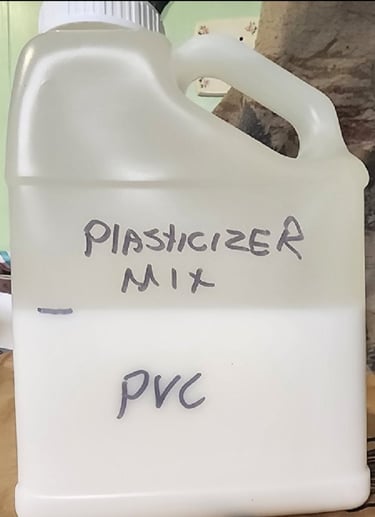
This is 1 gallon of RAW Non Phthalate Medium Shore A Soft Flexible PVC. The PVC pellets (powder) are suspended in Plasticizer Compound.
This is enough PVC to make a roll
.4mm thick x 1m wide x 30.5m Long
The best way to prolong the life of your squeaks, is proper care.
Keeping them clean, free of dust, skin oils, bodily fluids and other environmental contaminates.
Use the proper soaps, do not use soaps that contain (Alkylbenzene sulfonate and amine oxides)(Degreaser). These substances will pull plasticizer. Always dilute your soap to 25% consistency, example; 25% soap to 75% water and mix.
In a (16 oz./473 ml) spray bottle (4oz / 118ml) soap to (12oz./355ml) of water... This doesn't have to be exact, but close is best.
A Non Marine water based protectant can help prolong the life of your squeaks, most contain silicone which will help keep contaminates from leaching into the vinyl and causing plasticizer loss.
Always clean before storage, that way contaminates are not trapped against the vinyl where it can cause degradation.
Materials;
Phthalate, Non phthalate, Polyolefin, and TPU
Phthalate mixes were banned in food products, Medical products, and in children's Toys, and a few others. But not all squeaks. Many Customs still have phthalate plasticizers.
Non Phthalate, well some like it and some don't, it's a matter of preference.
Polyolefin; (Pvc is pretty stretchy by itself, but in recent years people have mentioned that they want something a little more stretchy, so the manufactures answered with a compound containing polyolefin, polyolefin (polyurethane) is added to the pvc mix prior to the plasticizer mix, this gives the pvc base material a higher gloss and is more pliable. the higher the poly content, the more stretchy the material gets. So for example; a Pvc base squeak with a poly/pvc mix of 60% poly to 40% Base pvc, this adds approx. .50" of total stretch to the material (this depends on plasticizers and etc. too) So the new materials that are so crazy stretchy and are environmentally friendly are 90+% poly. This comes with issues of its own, for every 10% poly added, it reduces average engineered longevity by 5%, it has a good cold tolerance, but a bad high temperature tolerance, It also reacts differently to solvents.
TPU Thermoplastic Polyurethane; High Grade TPU has a good resistance to temperature, abrasion, penetration, wear, and is non toxic. TPU also comes with some negative aspects, such as Cost, High grade TPU costs 3 to 4 times more than normal pvc and has a shorter life span, environmental degradation, TPU also has a low tolerance for UV radiation.
The key here is High Grade TPU... If the company you're dealing with has a history of short cuts. (Be careful) Same goes with PVC...
If you would like to go any further with this, we can chat about it on the forum.
Some of the new squeaks that have been bred with in the last few years are bred from a high polyolefin content PVC, and to make it even worse, the colorant used is an alcohol based paint or dye.
So to break this down, the high poly content PVC has a much shorter engineered longevity and has a lower tensile strength. It is very stretchy, but the down fall is that once the material reaches it's maximum stretch threshold, it will fail.
And since it's high in poly content, the Plasticizer is more vulnerable as there's not as much of it in the compound.
Alcohol-based paints and dyes can react with chlorinated water. The alcohol component acts as an organic solvent that, when mixed with chlorinated water, can lead to chemical reactions, discoloration, or degradation of the paint or dye, and since Alcohol degrades PVC, the underlying surface already has plasticizer damage leading to premature degradation.
Gov. agencies from around the world are starting to pay attention, people are developing illnesses from the mixing of plasticizers and compounds without the proper qualifications to back up their advice.

The world of Squeaky Friends
They make a bad day good and a good day better..
To add submissions or to contact the admins;
Send email by using button below or contact us via the forum...
Thanks for Visiting
© squeaksrus 2025.
All rights reserved.
Site Warnings;
They are not for human consumption and can pose choking or poisoning hazards to children and pets.
Flexible plastics often contain phthalates, dioxin, and heavy metals like lead. These can leach into the environment, potentially harm all that come in to contact with it.
Some flexible plastics can melt or cause a "gooey mess" if mixed with incorrect substances such as but not limited to; Plasticizers, Degreasers, Solvents, Adhesives, and High heat.
Products should be filled with air that contains 21% oxygen